> For the complete documentation index, see [llms.txt](https://docs.panther.com/llms.txt). Markdown versions of documentation pages are available by appending `.md` to page URLs; this page is available as [Markdown](https://docs.panther.com/ko/data-onboarding/supported-logs/docusign.md).
# Docusign 로그
Panther는 Docusign Connect webhook 이벤트를 수집하는 것을 지원합니다
## 개요
Panther는 수집을 지원합니다 [Docusign](https://www.docusign.com/) HTTP를 통해 웹훅 이벤트를 연결합니다. [Docusign Connect](https://developers.docusign.com/platform/webhooks/connect/) Docusign Connect를 사용하면 eSignature 워크플로에서 특정 이벤트가 발생할 때 Panther와 같은 외부 애플리케이션에 알림을 보내는 웹훅을 구성할 수 있습니다.
Docusign Connect 웹훅은 봉투(전송됨, 전달됨, 완료됨, 또는 무효화됨), 수신자, 템플릿, 신원 확인 등 다양한 엔터티에 대한 실시간 알림을 제공할 수 있습니다. 여기에서 [사용 가능한 이벤트 트리거의 전체 목록을 확인하세요](https://developers.docusign.com/platform/webhooks/connect/event-triggers/).
Panther의 Docusign 로그 통합을 다음 용도로 사용할 수 있습니다:
* **무단 접근 및 사기 탐지**: 실패한 인증 시도, 의심스러운 수신자 행동, 비정상적인 서명 패턴, 예상치 못한 봉투 수정 추적
* **템플릿 보안 모니터링**: 문서 템플릿의 생성, 수정 또는 삭제 모니터링
* **계정 활동 모니터링**: 관리 작업 및 구성 변경 추적
### 보안 모니터링에 일반적으로 사용되는 Docusign 이벤트 트리거
다음 [이벤트 트리거](https://developers.docusign.com/platform/webhooks/connect/event-triggers/) 는 보안 모니터링에 일반적으로 사용됩니다:
* `recipient-authentication-failure`: 인증 실패
* `envelope-voided`: 봉투 취소(잠재적 사기)
* `envelope-corrected`: 문서 수정(잠재적 변조)
* `template-created`, `template-modified`, `template-deleted`: 템플릿 변경
* `recipient-declined`: 문서 거부
## Docusign 로그를 Panther에 온보딩하는 방법
### 사전 요구 사항
* Docusign Connect 웹훅을 구성하려면 Docusign 계정에 관리자 권한이 있어야 합니다. 다음을 참조하세요 [Docusign Connect 문서](https://developers.docusign.com/platform/webhooks/connect/) 자세한 정보를 보려면.
### 1단계: Panther에서 새 Docusign 소스 만들기
1. Panther Console의 왼쪽 탐색 모음에서 **로그 소스**.
2. 클릭합니다 **새로 만들기**.
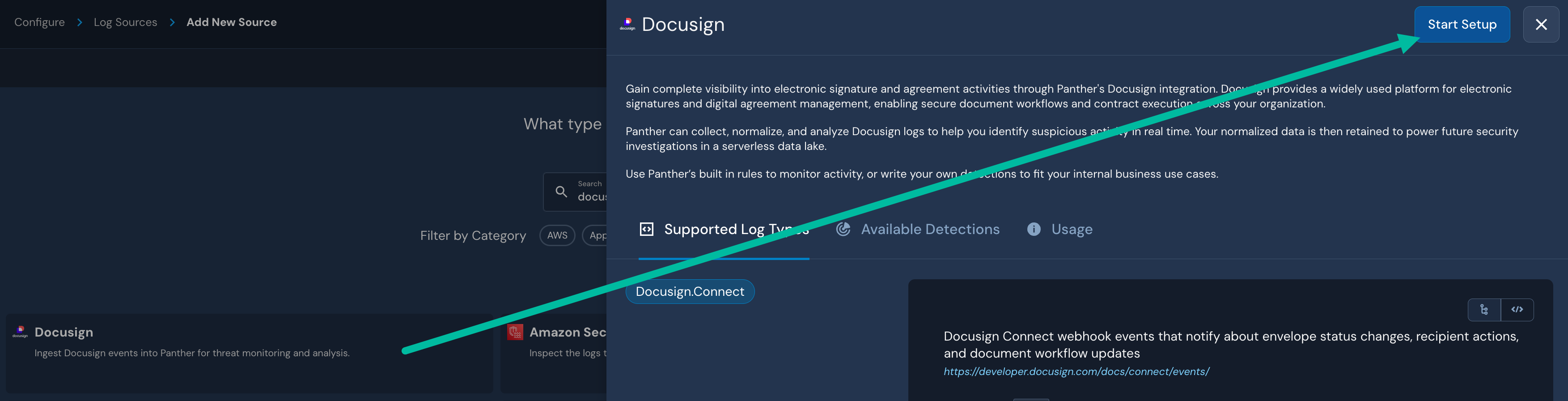
3. 「Docusign」을 검색한 다음 해당 타일을 클릭합니다.
4. 클릭합니다 **설정 시작**.
5. Panther의 [HTTP 소스 구성 지침을 따르세요](/ko/data-onboarding/data-transports/http.md#how-to-set-up-an-http-log-source-in-panther), 5단계부터 시작합니다.
* 설정 중에는, 다음에 대해 **인증 방식**다음 중 하나를 사용해야 합니다 **기본 인증** 또는 **HMAC**.
* 선택한 경우 **HMAC**, 다음에 대해 **헤더 이름**, 다음을 입력합니다 `X-Docusign-Signature-1`. [Connect 웹훅에서 HMAC을 사용하는 방법은 여기에서 자세히 알아보세요](https://developers.docusign.com/platform/webhooks/connect/hmac/).
* 구성한 인증 세부 정보를 저장하세요. 다음 단계에서 Docusign에서 웹훅을 설정할 때 필요합니다.
* 이 소스로 전송되는 페이로드는 [모든 HTTP 소스의 페이로드 요구사항](/ko/data-onboarding/data-transports/http.md#payload-requirements).
* HTTP 엔드포인트 생성이 완료될 때까지 다음 단계로 진행하지 마세요.
### 2단계: Docusign Connect 웹훅 구성하기
아래 단계를 따라 Docusign Connect 웹훅을 구성하세요. 이 과정에서 추가 지원이 필요하면 다음을 참조하세요 [Docusign의 Connect 구성 만들기 문서](https://support.docusign.com/s/document-item?language=en_US&_gl=1*jyc3me*_gcl_au*MTM1MDY1NDYyMS4xNzUzODgzNTcx\&bundleId=vob1727899215236\&topicId=xwi1583277389681.html&_LANG=enus).
1. 관리자 권한으로 Docusign 계정에 로그인하세요.
2. 탐색 모음에서 다음을 클릭합니다. **Integrations** > **연결**.
3. 클릭합니다 **구성 추가** > **사용자 지정**.
4. 다음을 구성합니다 [웹훅 Connect 필드](https://support.docusign.com/s/document-item?language=en_US\&bundleId=vob1727899215236\&topicId=zjq1665170940873.html&_LANG=enus):
* **이름**: 설명이 되는 이름을 입력합니다. 예: `Panther 보안 통합`.
* **게시할 URL**: 다음을 입력하세요. **HTTP 소스 URL** 1단계에서 Panther에서 생성한
* **트리거 이벤트**: 다음을 선택합니다 [이벤트 트리거](https://developers.docusign.com/platform/webhooks/connect/event-triggers/) 모니터링하려는
* **데이터 포함**: 각 카테고리별로 Panther로 전송되는 이벤트에 포함할 필드를 선택하세요. 이 필드에 대해 자세히 알아보려면 이 [Docusign 문서](https://support.docusign.com/s/document-item?language=en_US\&bundleId=vob1727899215236\&topicId=zbg1608069790210.html&_LANG=enus).
{% hint style="warning" %}
다음의 경우 **봉투** 및 **수신자** 이벤트의 경우, 다음은 그대로 두는 것이 좋습니다 **문서** 및 **첨부 파일** 선택하지 않음으로 설정하세요. 이렇게 하면 payload 크기를 줄여 잠재적인 이벤트 전달 지연을 방지할 수 있습니다. 자세히 알아보려면 [대신 eSignature API를 통해 문서를 검색하는 방법은 여기에서 확인하세요](https://support.docusign.com/s/document-item?language=en_US&_gl=1*jyc3me*_gcl_au*MTM1MDY1NDYyMS4xNzUzODgzNTcx\&bundleId=vob1727899215236\&topicId=oza1583277387805.html&_LANG=enus).
{% endhint %}
* **HMAC 서명 포함**: 1단계에서 Panther에서 HMAC 인증을 사용한 경우 여기에 체크하세요.
* 다음 **1.** 필드에 HMAC을 입력하세요 **헤더 이름** 1단계에서 Panther에 입력한 값을. Docusign은 이 값을 다음과 연결하여 전송합니다 `X-Docusign-Signature-1` 헤더.
* 다음에서 자세히 알아보세요 [Docusign Connect에서 HMAC 보안 사용 문서](https://developers.docusign.com/platform/webhooks/connect/hmac/).
* **기본 인증 헤더 포함**: 1단계에서 Panther에서 기본 인증을 사용한 경우 여기에 체크하세요.
* **사용자 이름**: 다음을 입력하세요. **사용자 이름** 1단계에서 Panther에 입력한 값.
* **비밀번호**: 다음을 입력하세요. **비밀번호** 1단계에서 Panther에 입력한 값.
5. 클릭합니다 **구성 추가**.
## 지원되는 로그 유형
### Docusign.Connect
봉투 상태 변경, 수신자 작업, 문서 워크플로 업데이트 등에 대해 알려주는 Docusign Connect 웹훅 이벤트입니다.
참조: [Docusign Connect JSON SIM 이벤트 모델](https://developers.docusign.com/platform/webhooks/connect/json-sim-event-model/)
```yaml
schema: Docusign.Connect
description: 봉투 상태 변경, 수신자 작업, 문서 워크플로 업데이트 등에 대해 알려주는 Docusign Connect 웹훅 이벤트
referenceURL: https://developers.docusign.com/platform/webhooks/connect/json-sim-event-model
필드:
- 이름: event
필수: true
description: 웹훅을 트리거한 이벤트 유형(예: recipient-sent, envelope-completed).
유형: string
- name: uri
description: 봉투 리소스의 REST API URI.
유형: string
- name: retryCount
description: 이 웹훅 전달의 재시도 횟수.
유형: string
- 이름: configurationId
description: 이 웹훅을 생성한 Connect 구성 ID.
유형: string
- 이름: apiVersion
description: 이 이벤트에 사용된 Docusign API 버전.
유형: string
- name: generatedDateTime
필수: true
description: Docusign이 이벤트를 생성한 시점.
유형: timestamp
시간 형식:
- rfc3339
이벤트 시간 여부: true
- 이름: data
필수: true
description: 이벤트 정보를 포함한 주요 이벤트 데이터.
유형: object
필드:
- name: accountId
description: 보낸 사람의 계정을 식별하거나, Recipient Connect의 경우 수신자의 계정을 식별합니다.
유형: string
지표:
- trace_id
- 이름: userId
description: 이 이벤트와 관련된 사용자 ID
유형: string
지표:
- trace_id
- name: recipientId
description: 이 이벤트와 관련된 수신자 ID
유형: string
지표:
- trace_id
- name: envelopeId
description: 이 이벤트와 관련된 봉투를 식별합니다.
유형: string
지표:
- trace_id
- 이름: name
description: 관련 템플릿 이벤트의 이름 또는 봉투가 재할당된 사람의 이름.
유형: string
- 이름: email
description: 봉투가 재할당된 사람의 이메일 주소.
유형: string
지표:
- email
- name: routingOrder
description: 봉투가 재할당된 사람의 라우팅 순서.
유형: string
- 이름: created
description: 템플릿이 생성/수정/삭제된 UTC 날짜 및 시간.
유형: timestamp
시간 형식:
- rfc3339
- name: templateId
description: 생성/수정/삭제된 템플릿 ID.
유형: string
지표:
- trace_id
- name: clickwrapId
description: 동의되거나 거부된 elastic 템플릿을 식별합니다.
유형: string
지표:
- trace_id
- name: agreementId
description: elastic 템플릿 내의 agreement를 식별합니다.
유형: string
지표:
- trace_id
```
## 사용자 지정 디택션 패턴
Docusign용 사용자 지정 디택션을 작성할 때 다음과 같은 일반적인 패턴을 사용할 수 있습니다:
```python
# 특정 이벤트 유형 확인
event_type = event.get('event')
# 인증 실패 모니터링
if event_type == 'recipient-authentication-failure':
return True
# 봉투 무효화 모니터링(잠재적 사기 지표)
if event_type == 'envelope-voided':
return True
```
```python
# 봉투 및 발신자/수신자 데이터 액세스
envelope_id = deep_get(event, 'data', 'envelopeId')
account_id = deep_get(event, 'data', 'accountId')
```
## Docusign 로그 쿼리
에서 Docusign 로그를 쿼리하려면 [데이터 탐색기](/ko/search/data-explorer.md):
```sql
-- 최근 Docusign 이벤트 보기
SELECT event, generatedDateTime, data:envelopeId, data:email
FROM panther_logs.docusign_connect
WHERE p_occurs_since('1 day')
ORDER BY p_event_time DESC;
-- 인증 실패 모니터링
SELECT *
FROM panther_logs.docusign_connect
WHERE event = 'recipient-authentication-failure'
AND p_occurs_since('7 days')
ORDER BY p_event_time DESC;
-- 봉투 상태 변경 추적
SELECT event, data:envelopeId, data:accountId, generatedDateTime
FROM panther_logs.docusign_connect
WHERE event LIKE 'envelope-%'
AND p_occurs_since('1 day')
ORDER BY generatedDateTime DESC;
```
---
# Agent Instructions
This documentation is published with GitBook. GitBook is the documentation platform designed so that both humans and AI agents can read, navigate, and reason over technical content effectively. Learn more at gitbook.com.
## Querying This Documentation
If you need additional information that is not directly available in this page, you can query the documentation dynamically by asking a question.
Perform an HTTP GET request on the current page URL with the `ask` query parameter, and the optional `goal` query parameter:
```
GET https://docs.panther.com/ko/data-onboarding/supported-logs/docusign.md?ask=&goal=
```
`ask` is the immediate question: it should be specific, self-contained, and written in natural language.
`goal` is optional and describes the broader end goal you are ultimately trying to accomplish on behalf of the user. GitBook uses it to tailor the answer towards what is most useful for that goal.
The response will contain a direct answer to the question and relevant excerpts and sources from the documentation.
Use this mechanism when the answer is not explicitly present in the current page, you need clarification or additional context, or you want to retrieve related documentation sections.