> For the complete documentation index, see [llms.txt](https://docs.panther.com/llms.txt). Markdown versions of documentation pages are available by appending `.md` to page URLs; this page is available as [Markdown](https://docs.panther.com/panther-developer-workflows/api/api-playground.md).
# API Playground
## Overview
Within the API Playground in the Panther Console, you can try out operations in the GraphQL API and REST API.
### How to access the Playground
{% hint style="info" %}
You must have the `View API Tokens` permission to access the Playground—see [Panther's Role-Based Access Control](/system-configuration/rbac.md) documentation for instructions on modifying user roles.
{% endhint %}
1. At the bottom of the left-hand navigation bar in your Panther Console, click **Settings**.
2. Navigate to **Developer Tools** > **API Playground**.
3. Using the tabs at the top of the window, select the API set you'd like to test: [GraphQL](/panther-developer-workflows/api/graphql.md) or [REST](/panther-developer-workflows/api/rest.md).
* The next time you visit the API Playground, you will be taken to whichever API you left off on.\\
{% hint style="warning" %}
Note:
* If you have just created an API token, please wait 30-60 seconds for the new token to become available to related distributed AWS services.
* For security purposes, the API token will **not** persist in the Playground when you refresh the page or navigate to a different page. You will need to re-enter the API token each time you use the Playground.
{% endhint %}
## GraphQL Playground
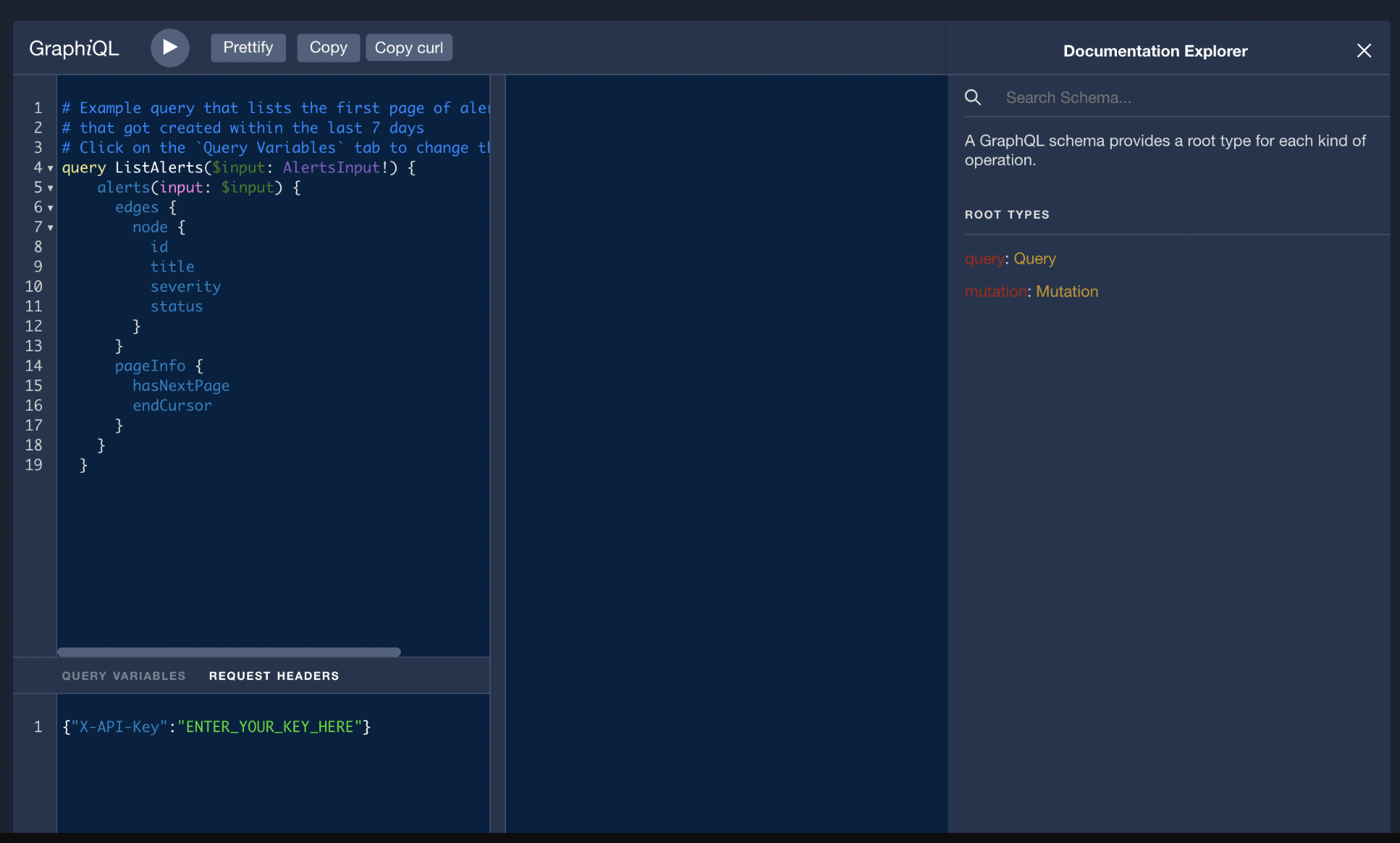
After you enter a valid API Token, click the "play" icon in the upper left corner to force your GraphQL query to run.
### Documentation Explorer
The Documentation Explorer in the Panther Console is one way to examine the Panther API schema. To learn about other ways, including a downloadable schema file, see [Discover the Panther GraphQL schema](/panther-developer-workflows/api/graphql.md#discover-the-panther-graphql-schema).
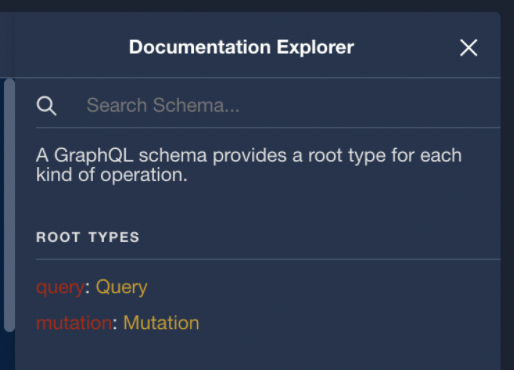
See the **Documentation Explorer** on the right side of the Playground. It displays the available queries and mutations, along with descriptions and types on every field and entity:
### Writing your own query
The autocomplete functionality and the Documentation Explorer assist with writing your own query. Additionally, there are three utility buttons near the top of the page:
* **Prettify** to help you format your query according to the GraphQL standards
* **Copy** to copy your query in order to paste it to the client that's going to issue the request
* **Copy curl** to copy a complete curl operation that you can paste into any UNIX system with the curl command-line tool installed.
An example of the curl command that would be copied from the Panther web application:
```
curl 'PANTHER_GRAPHQL_API_URL' \
-H 'Accept-Encoding: gzip, deflate, br' \
-H 'Content-Type: application/json' \
-H 'Accept: application/json' \
-H 'Connection: keep-alive' \
-H 'DNT: 1' \
-H 'Origin: http://{PANTHER_GRAPHQL_API_URL}/public/graphql' \
-H 'X-API-Key: {FAKE_API_KEY_WITH_USER_READ_PERMISSIONS}' \
--data-binary '{"query":"\n # Example query which lists users in your organization\n query Users {\n users {\n\t\t\tgivenName\n familyName\n email\n }\n }","variables":{}}' \
--compressed
```
## REST Playground
Use the REST Playground to explore and try out the Panther [REST API](/panther-developer-workflows/api/rest.md).
### How to set your API token
1. In the upper-right corner, click **Authorize**.\\
2. In the modal, enter your API key.
3. Click **Authorize**, then **Close**.
### Exploring API groups
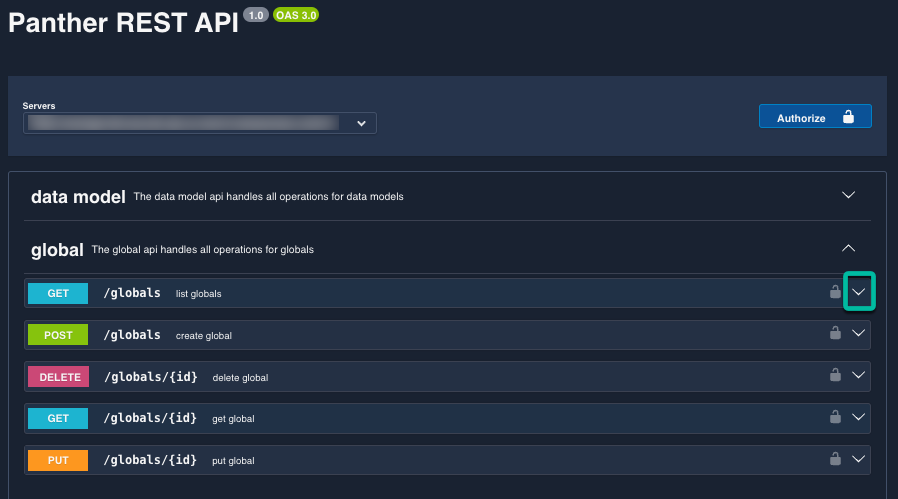
The API groups are listed first, collected together by URL path for each API. To view additional details for a certain endpoint, including request arguments and an example return payload, click the arrow on the right-hand side of an endpoint's row.
#### Sending requests
{% hint style="info" %}
To make a successful request, you must have already added your API token in the Playground. See [How to set your API token](#how-to-set-your-api-token), above.
{% endhint %}
To send a request in the Playground:
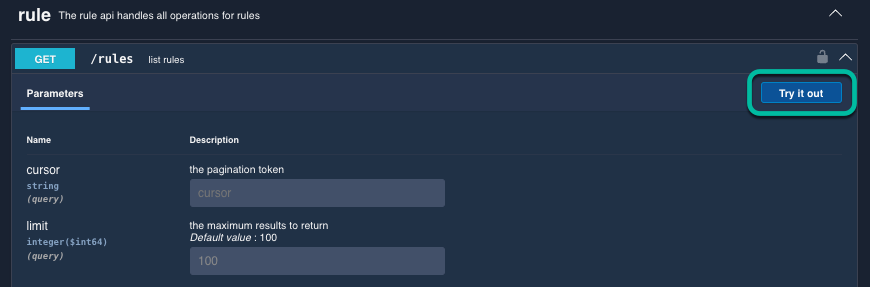
1. Within an expanded API endpoint, click **Try it out**.
2. In the **Parameters** section, provide values for required and optional parameters, as you see fit.
3. Click **Execute**.
### Viewing schemas
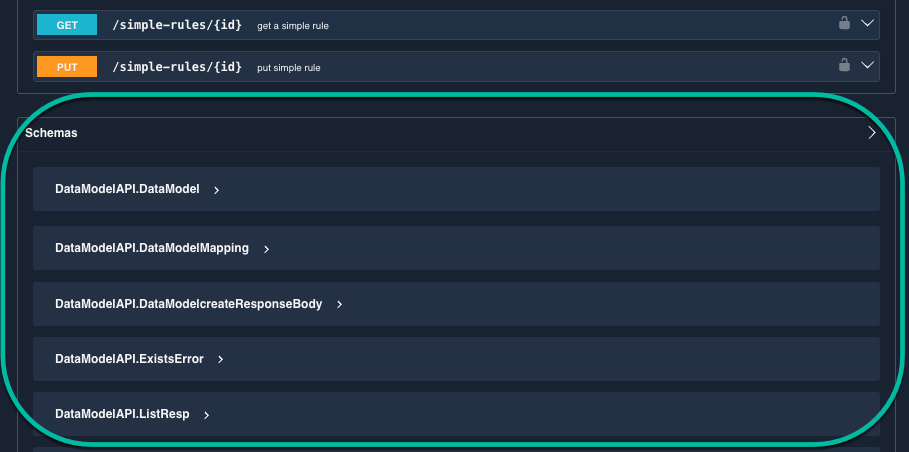
Below the API groups, the schemas for each data type are listed:
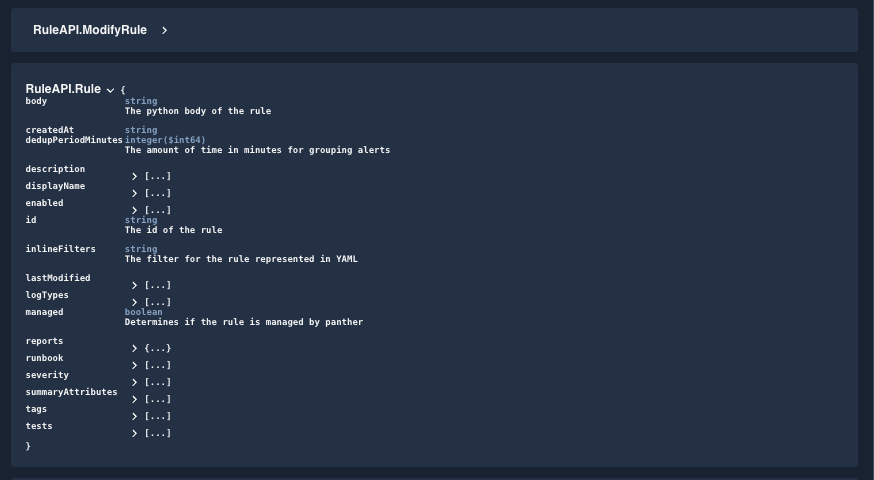
To view details of a certain data type, click its row to expand it:
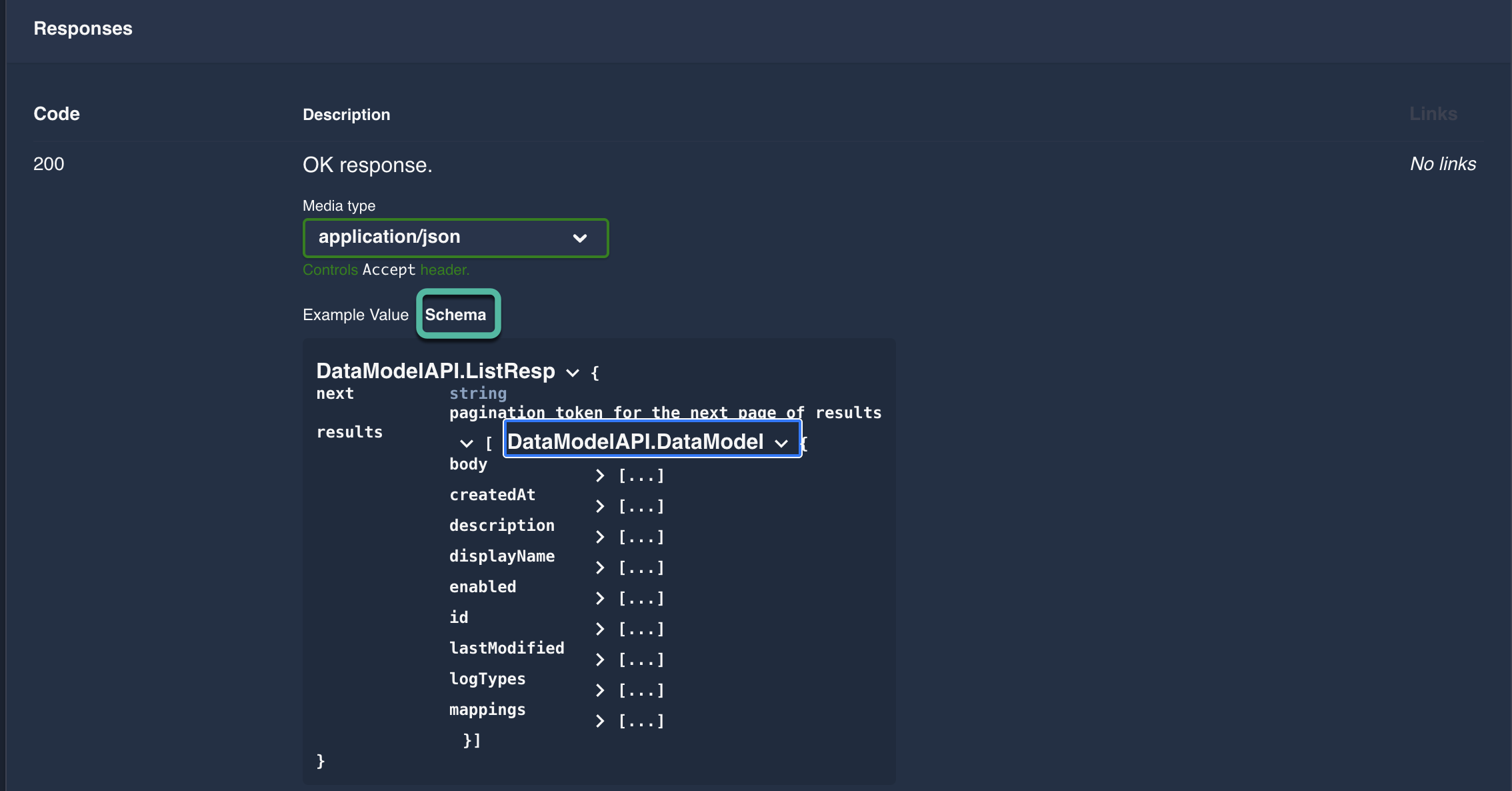
These schemas are also visible when [viewing the API groups](#exploring-api-groups). In the **Responses** section, next to **Example Value**, click **Schema**.
---
# Agent Instructions
This documentation is published with GitBook. GitBook is the documentation platform designed so that both humans and AI agents can read, navigate, and reason over technical content effectively. Learn more at gitbook.com.
## Querying This Documentation
If you need additional information that is not directly available in this page, you can query the documentation dynamically by asking a question.
Perform an HTTP GET request on the current page URL with the `ask` query parameter, and the optional `goal` query parameter:
```
GET https://docs.panther.com/panther-developer-workflows/api/api-playground.md?ask=&goal=
```
`ask` is the immediate question: it should be specific, self-contained, and written in natural language.
`goal` is optional and describes the broader end goal you are ultimately trying to accomplish on behalf of the user. GitBook uses it to tailor the answer towards what is most useful for that goal.
The response will contain a direct answer to the question and relevant excerpts and sources from the documentation.
Use this mechanism when the answer is not explicitly present in the current page, you need clarification or additional context, or you want to retrieve related documentation sections.