> For the complete documentation index, see [llms.txt](https://docs.panther.com/llms.txt). Markdown versions of documentation pages are available by appending `.md` to page URLs; this page is available as [Markdown](https://docs.panther.com/panther-developer-workflows/api/graphql/schemas.md).
# Schemas
Panther GraphQL API schema operations
## Overview
The Panther API supports the following schema operations:
* Creating or updating a custom schema
* Listing schemas
You can invoke Panther's API by using your Console's API Playground, or the GraphQL-over-HTTP API. Learn more about these methods on [Panther API](/panther-developer-workflows/api.md#step-1-choose-a-method-for-invoking-the-api).
See [Custom Logs](/data-onboarding/custom-log-types.md) to learn more about custom schemas in Panther.
### Required API token permissions
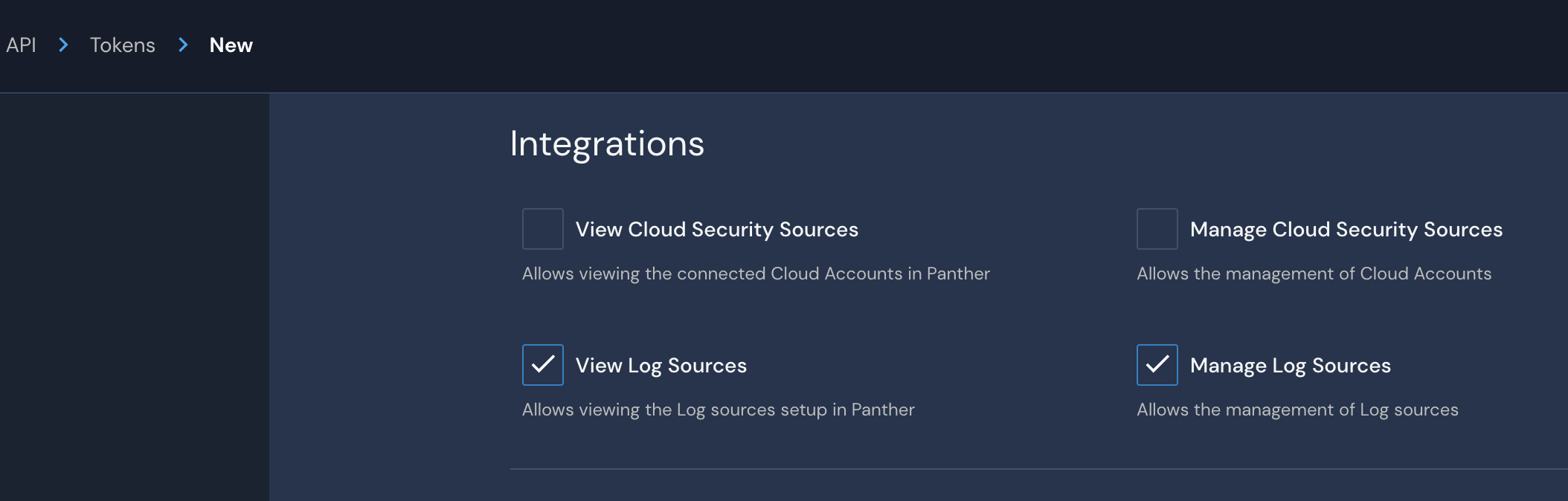
Before starting to make API calls, ensure your API token has the necessary permissions attached:
* **View Log Sources**: Required for all schema operations.
* **Manage Log Sources**: Required for the schema management operations that are mutations (i.e., `CreateOrUpdateSchema`).
* **Read User Info**: Required if you would like to retrieve integration fields related to an actor, such as `createdBy`.
## Common schema operations
#### Creating a custom schema
```graphql
mutation addSchema {
createOrUpdateSchema(input:{
description: "description"
name:"Custom.NewSchema",
isFieldDiscoveryEnabled: true,
spec:"""
fields:
- name: foo
type: string
"""
}) {
schema {
createdAt
description
isArchived
isManaged
name
referenceURL
revision
isFieldDiscoveryEnabled
spec
discoveredSpec
updatedAt
version
}
}
}
```
#### Listing schemas
This query lists all schemas, including custom and Panther-managed schemas.
{% hint style="info" %}
Pagination is not currently supported by `schemas`—all schemas will be returned in the first page of results. The `cursor` field in the `input` object, below, is a placeholder for when pagination is eventually supported.
{% endhint %}
```graphql
query ListSchemas {
schemas(input:{cursor:""}) {
edges {
node {
createdAt
description
isArchived
isManaged
name
referenceURL
revision
isFieldDiscoveryEnabled
spec
discoveredSpec
updatedAt
version
}
}
}
}
```
---
# Agent Instructions
This documentation is published with GitBook. GitBook is the documentation platform designed so that both humans and AI agents can read, navigate, and reason over technical content effectively. Learn more at gitbook.com.
## Querying This Documentation
If you need additional information that is not directly available in this page, you can query the documentation dynamically by asking a question.
Perform an HTTP GET request on the current page URL with the `ask` query parameter, and the optional `goal` query parameter:
```
GET https://docs.panther.com/panther-developer-workflows/api/graphql/schemas.md?ask=&goal=
```
`ask` is the immediate question: it should be specific, self-contained, and written in natural language.
`goal` is optional and describes the broader end goal you are ultimately trying to accomplish on behalf of the user. GitBook uses it to tailor the answer towards what is most useful for that goal.
The response will contain a direct answer to the question and relevant excerpts and sources from the documentation.
Use this mechanism when the answer is not explicitly present in the current page, you need clarification or additional context, or you want to retrieve related documentation sections.